
When Art Arrives Late
The Problem with Bringing Art Consultants in After the Architecture Is Finished
Why cultural strategy has to enter before walls, ceilings, lighting and budgets become excuses
By Mohamad Makouk, Team Leader, Core Art Strategies
Figure 1. Early art strategy changes the project. Late art consultancy negotiates with what the project has already fixed. Original diagram by Core Art Strategies.
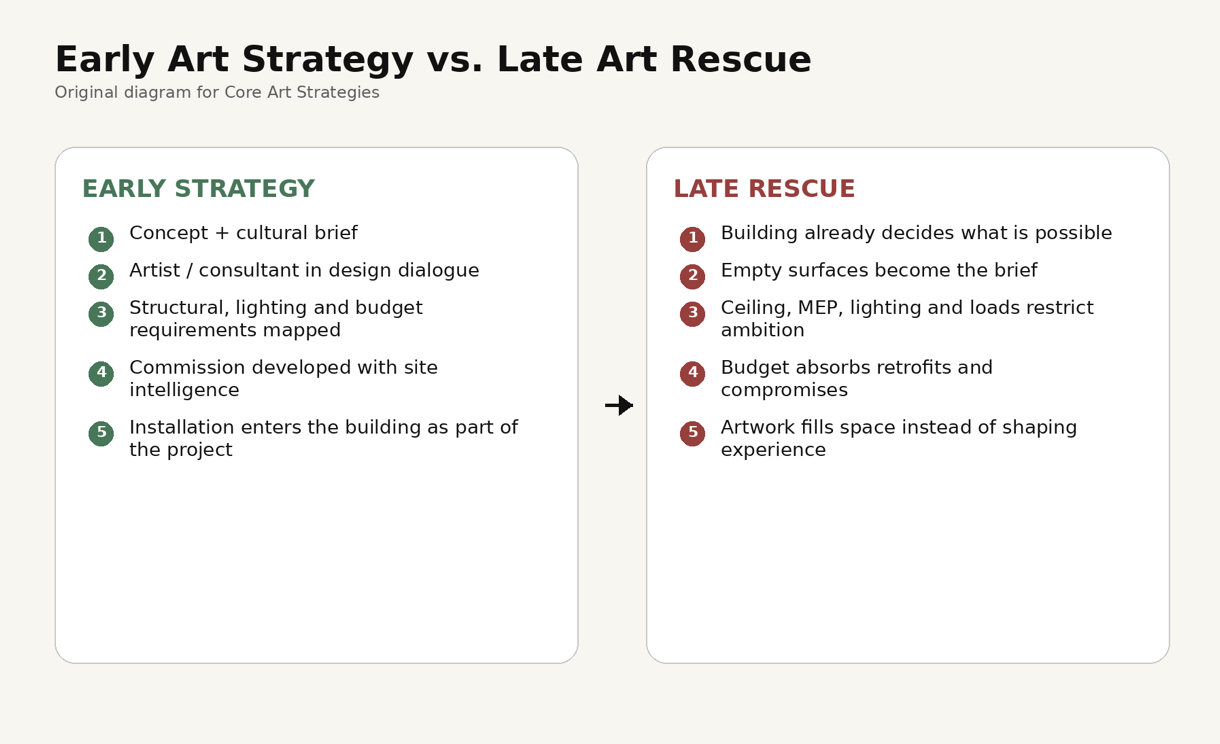
Most projects call the art consultant when the damage has already been designed.
The architecture is finished. The lighting is fixed. The ceilings are dense with services. The walls are closed. The lobby has been value-engineered into obedience. The landscape has been approved. The budget has been wounded. Then someone walks through the almost completed site, sees a long blank wall, and says the fatal sentence: we need art here.
That sentence is usually not the beginning of an art strategy. It is the beginning of a rescue operation.
The problem is not that the project wants art. Most ambitious hospitality, corporate, public realm and cultural projects need art badly. They need it because architecture alone cannot always carry identity, memory or emotional charge. But by the time the art conversation begins, the building has already made most of the decisions that determine what kind of art can exist. The consultant is no longer shaping possibility. The consultant is negotiating with leftovers.
This is the quiet failure behind many expensive environments in the Gulf and beyond. The space contains art, but the art does not contain the space. It has presence without necessity. It photographs well, behaves politely and changes very little. It becomes evidence that money was spent, not proof that cultural thinking took place.
Public art guidance is unusually clear on this point. CreateSA notes that works of art should ideally be commissioned as part of a considered process of place creation, targeted to a particular place, and that earlier artist engagement generally produces stronger outcomes when the design team wants to understand opportunities for integration. 1 The Watford Public Art Commissioning Toolkit makes the same argument from the side of the design team: an artist can contribute meaningfully to a construction or public realm project when engaged from the outset and allowed to work collaboratively at concept and design stage. 2
These are not romantic statements about creativity. They are operational facts. If art is expected to shape space, then art must arrive while space is still negotiable.
The late brief is not a brief
The late-stage model is built on a convenient fiction: architecture first, interiors second, branding third, art last. It sounds orderly. It is also one of the fastest ways to reduce art to a surface treatment. In that sequence, culture is asked to behave after everyone else has already spoken. The result is predictable. Art fills the wall, occupies the corner, softens the atrium, distracts from the corridor, dignifies the boardroom, or adds prestige to the reception area. It is visible, but structurally irrelevant.
A serious art consultant works differently. The role is not simply to select artists or procure objects. It is to read a project before it hardens. It is to understand the architecture, the movement of people, the symbolic pressure of the site, the client’s public identity, the budget, the engineering constraints, the maintenance realities and the cultural atmosphere the project claims to produce. The consultant identifies where art can become a spatial event, where it should remain quiet, where it can support public life, where it can create friction, where it should resist the architecture, and where it should leave the room alone.
This is why early consultancy is not a luxury. It is risk management disguised as cultural intelligence.
Late commissioning usually damages four things: concept, scale, budget and authorship. Concept suffers because there is no time for real research. The work begins with options, not questions. Scale suffers because the building’s structure and services have already limited what is physically possible. Budget suffers because the project must now pay to retrofit what could have been planned. Authorship suffers because artists are brought in to solve a problem they did not help define.
Anyone who has produced large-scale work knows the brutal comedy of the late brief. The client wants a suspended installation, but the ceiling cannot carry it. They want an outdoor sculpture, but the wind loads and maintenance plan were never discussed. They want an immersive lobby, but the lighting was designed for generic luxury, not artwork. They want a public-facing intervention, but approvals, access and civic visibility were never mapped. They want meaning, but they have left no room for it.
In public art, the technical is never separate from the poetic. Power supply, access, structural load, lighting, fire strategy, climate exposure, installation route, cleaning method, conservation plan and public behaviour are not administrative details. They are the conditions through which the artwork either becomes real or becomes compromised. The American Public Transportation Association’s best-practice document on integrating art into capital projects describes art and design as linked practices that can improve customer experience, strengthen identity and add vibrancy to public space when managed by experienced art professionals. 3 That logic applies far beyond transit. It applies to airports, museums, hotels, resorts, headquarters, cultural districts and urban developments.
The earlier the art consultant enters, the more useful the consultant becomes. At concept stage, the consultant can help define cultural ambition. At schematic stage, they can identify where art can become structural, spatial or atmospheric. During design development, they can translate artistic intent into technical requirements. During construction, they can manage fabrication, approvals, risk, logistics and installation without pretending that miracles are a method.
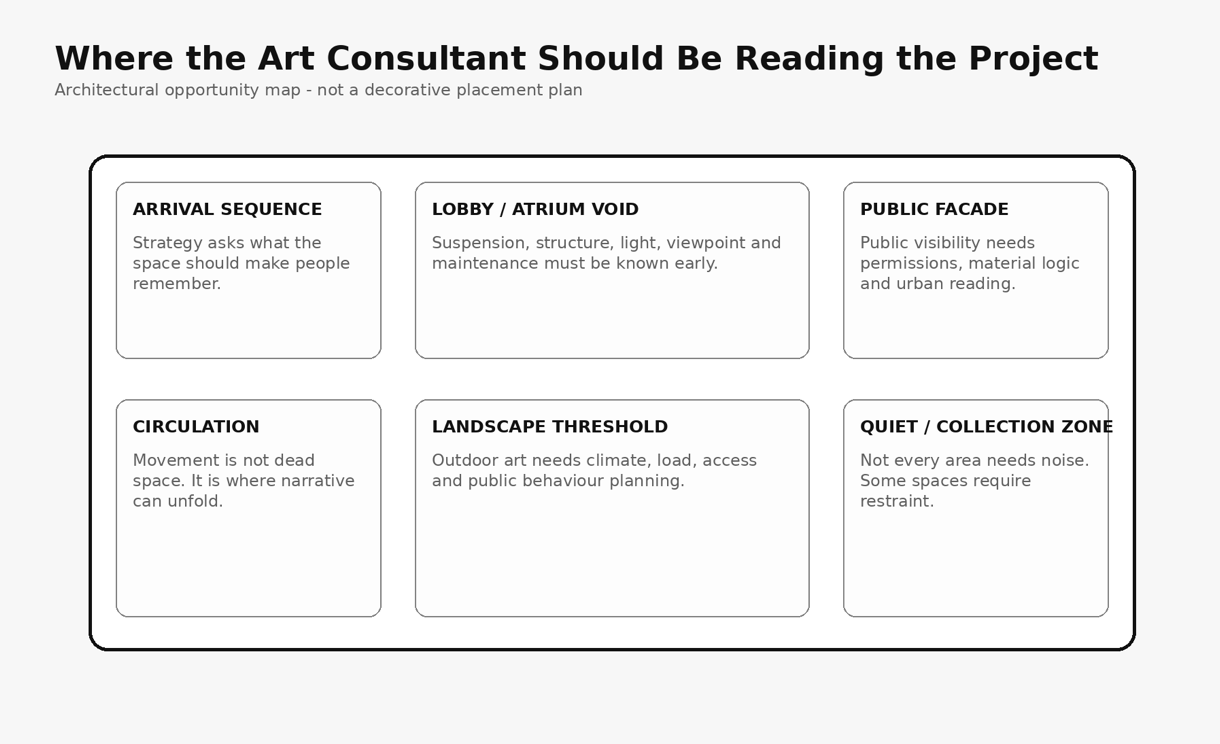
Figure 2. An art consultant reads the building for cultural and technical opportunities before the architecture closes them down. Original diagram by Core Art Strategies.
Late art consultancy, by contrast, often becomes the management of disappointment. Not because the consultant lacks imagination, but because the project has already spent its imagination elsewhere.
Art is a spatial discipline before it is a procurement category
The best art strategies do not begin with artist names. They begin with a diagnosis of the project. What is the psychological centre of the building? Where does the visitor first understand the place? Where does the project reveal its intelligence? What should happen in the public realm? What kind of memory does the space want to produce? What should be permanent, temporary, commissioned, acquired, programmed or avoided? Which local, regional or international voices actually belong to the project’s logic?
These questions matter because art is frequently used as a shortcut to cultural credibility. A famous artist in a lobby can make a project look serious for a press release. It does not necessarily make the project culturally serious. Cultural seriousness comes from relation, not simply value. The work must relate to site, audience, material, movement, context and institutional ambition. Without that relation, art becomes a nameplate in a large room.
Project for Public Spaces argues that the success of public art depends heavily on the design and life of the public space around it. A work can fail as a placemaking device if the site is unsafe, badly connected, poorly maintained or lacking reasons for people to stay. It also argues that public art is strongest as part of a larger holistic and multidisciplinary approach to enlivening places. 4 This is crucial. Art cannot repair a dead public space by itself. It can intensify life where life has been designed to occur. It can also expose the absence of that life.
For hospitality projects, the problem is slightly different but just as serious. Many hotels now understand that guests want atmosphere, specificity and story. They also misunderstand how those things are built. Culture is not produced by adding regional motifs to a corridor or hanging expensive paintings near reception. A hotel becomes memorable when art, light, material, sound, circulation and service experience generate a coherent psychological climate. That climate cannot be installed in the final month before opening.
For corporate headquarters, art is often asked to perform institutional dignity. This can become tragic very quickly. The usual formula is familiar: a large entrance work, a few boardroom pieces, a reception statement, perhaps a regional reference, and enough abstraction to offend nobody. The result is safe, expensive silence. A stronger corporate art strategy asks harder questions. What does the organization want to project? What does it actually do? How does the building express power, labour, geography, public responsibility or ambition? Where can art produce identity without becoming propaganda?
For cultural and public realm projects, the stakes are higher because the audience is broader and the political life of the work is less controllable. Public art is not only seen. It is passed, ignored, touched, photographed, challenged, loved, vandalized, maintained, discussed and absorbed into daily life. It needs a commissioning process mature enough to handle those realities. Americans for the Arts and the Public Art Network define commissioning agents broadly, including art administrators, consultants, developers and other teams acting for a commissioning body, and their best-practice standards insist on clear scope, budget, schedule, fair process, artist compensation, written agreements and maintenance planning. 5 In other words, the beauty of the final work depends on the ethics and clarity of the process that produced it.
This is where Core Art Strategies positions its work: not as post-design styling, but as cultural planning attached to execution. Under the leadership of Mohamad Makouk, the practice argues for a more precise role for the art consultant in the GCC and international project markets. The art consultant should not arrive with catalogues after the building has already eliminated the best possibilities. The consultant should be present when the project is still able to ask intelligent questions about experience, identity, memory, circulation and public value.
For the Gulf, timing is cultural policy
There is a practical reason for this. Integrated art requires integrated information. If a work is suspended, structural coordination is not optional. If it emits light, electrical and maintenance coordination matter. If it sits outdoors, climate, materials, anchoring and public interaction matter. If it belongs to a hotel, operational durability matters. If it belongs to a public institution, access, interpretation and stewardship matter. If it belongs to a corporate collection, ownership, insurance and long-term collection management matter. These concerns are not enemies of creativity. They are the framework that protects it from becoming theatre.
Modus Operandi’s commissioning guidance states that there is no single methodology for commissioning art and that strategies should be as unique and site-specific as the artworks they seek to generate. It also notes that turning a vision into reality requires knowledge, skill, tenacity and sensitivity. 6 That is the exact territory of the serious art consultant. The work is not only aesthetic judgement. It is translation between ambition and reality.
Developers often delay art because they believe delay creates control. They want to see the architecture first, finalize interiors, understand remaining budget and postpone complexity. The instinct is understandable. It is also expensive. Late decisions do not remove complexity. They concentrate it into the most stressful and least flexible phase of the project.
Early art strategy does not mean buying art early. It means thinking early. It means setting ambition, protecting budget, identifying opportunities, preventing technical impossibilities, developing realistic briefs and understanding where the project can produce cultural value. It means knowing when a wall should remain empty because emptiness has force, and when a ceiling should be engineered because the whole identity of the project could depend on what descends through that void.
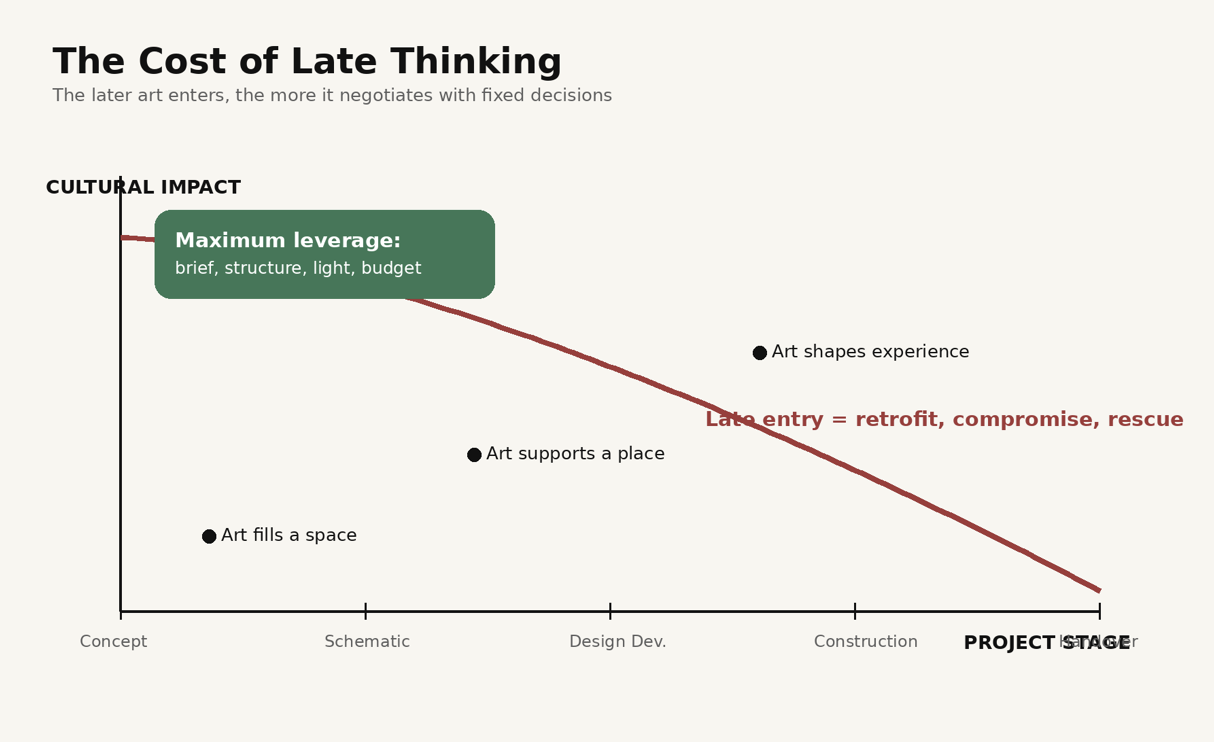
Figure 3. The cost of late thinking is not only financial. It is conceptual, technical and atmospheric. Original diagram by Core Art Strategies.
The Gulf is particularly exposed to this problem because so many projects are built at enormous speed and scale. Hotels, resorts, headquarters, museums, mixed-use developments and cultural districts are often asked to carry regional identity, global prestige and investment logic at the same time. The temptation is to use art as a prestige layer. That temptation produces rooms full of expensive objects and very little cultural consequence.
The better opportunity is more difficult and more valuable: to integrate art as a form of spatial intelligence. Not every project needs a masterpiece. Some need a strong commissioning framework. Some need a temporary programme. Some need artist-led research. Some need an integrated light work, a landscape intervention, a collection strategy, a publication, a public engagement plan or a curatorial refusal. Knowing the difference is the work.
The problem with bringing art consultants in after the architecture is finished is ultimately not only logistical. It is intellectual. By then, the project has already decided where meaning can and cannot happen. The consultant can still produce something elegant. Sometimes even something strong. But the work is forced to act against a finished body rather than through a living one.
The question is not where to put art
If a project wants art to matter, it has to make room for art before the room is already finished. It has to treat the art consultant not as a final supplier, but as a strategic reader of space, public experience and cultural value. It has to understand that the question is not where can we put art? The question is what could this project become if art were allowed to think with it from the beginning?
References1. CreateSA, Public Art Commissioning Guidelines, lines 49-63. The guidelines state that artworks should be commissioned as part of a considered process of place creation and that earlier artist engagement generally leads to more successful outcomes when integration is sought. https://www.create.sa.gov.au/__data/assets/pdf_file/0004/1067044/Project-Seed-Funding-Commissioning-Guidelines.pdf2. Watford Borough Council, Public Art Commissioning Toolkit 2025, lines 245-263. The toolkit describes the artist-in-design-team model and recommends early appointment so art can be integrated into development. https://watford.moderngov.co.uk/documents/s49705/Appendix%2B2%2B-%2BPublic%2BArt%2BCommissioning%2BToolkit.pdf3. American Public Transportation Association, Best Practices for Integrating Art into Capital Projects, lines 37-65 and 109-128. The document describes the benefits of integrated art and the role of art professionals in capital projects. https://www.apta.com/wp-content/uploads/Standards_Documents/APTA-SUDS-UD-RP-007-13_Booklet_Version.pdf4. Project for Public Spaces, Collaborative Creative Placemaking: Good Public Art Depends on Good Public Spaces, lines 88-92. The article emphasizes that public art succeeds as part of a holistic, multidisciplinary approach to public space. https://www.pps.org/article/collaborative-creative-placemaking-good-public-art-depends-on-good-public-spaces5. Americans for the Arts / Public Art Network, Best Practices for Commissioning Public Art Projects, lines 0-19 and 46-131. The standards address scope, budget, schedule, artist compensation, written agreements and maintenance planning. https://c46b5ef69e51454aa4fd-366ec602bfd486cb0de1bffec2f36b7e.ssl.cf2.rackcdn.com/afta_4f35d00aa53f6c76a143ed12176b3930.pdf6. Public Art Online / Modus Operandi, Commissioning Guidelines, lines 41-60. The guidance argues for site-specific commissioning strategies and professional knowledge in turning vision into reality. https://publicartonline.org.uk/resources/practicaladvice/commissioning/modusoperandi_guidelines.php.htmlEditorial note: The diagrams are original Core Art Strategies visuals and can be replaced by project photography, annotated plans or approved portfolio images before publication.